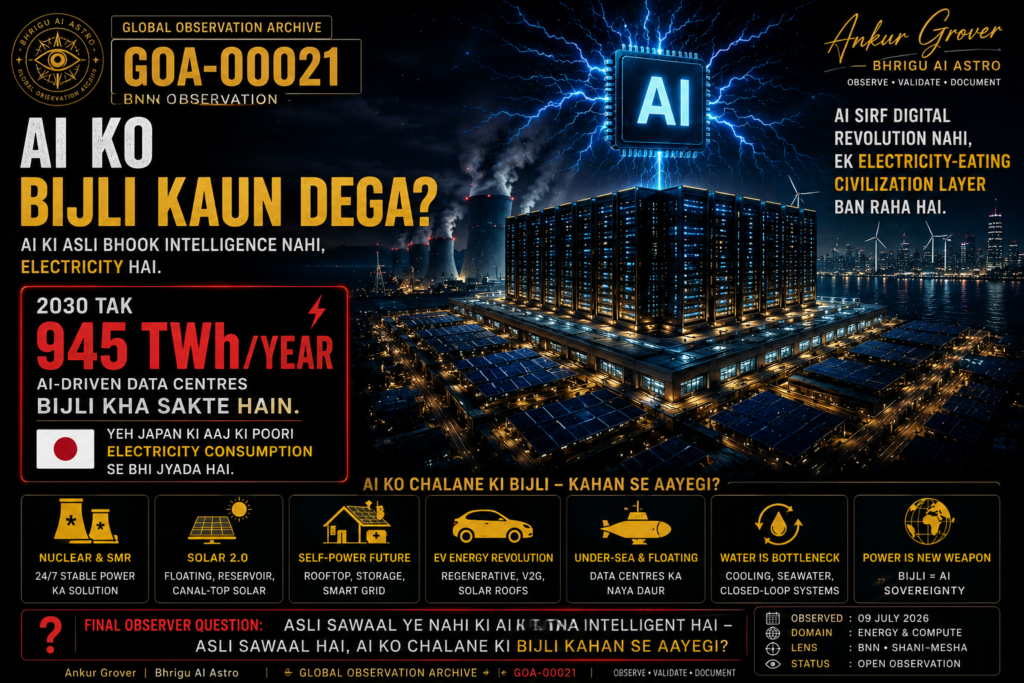
Global Observation Archive · GOA-00021
AI Ko Bijli Kaun Dega?
Sab AI ki baat kar rahe hain. Par koi asli sawaal nahi pooch raha — is intelligence ko chalane wali electricity aayegi kahan se.
Lede
AI sirf ek digital revolution nahi hai. Yeh dheere-dheere ek electricity-eating civilization layer ban raha hai — jise chalane ke liye real bijli, real paani, real cooling, real zameen aur real grid capacity chahiye.
AI-driven data centres
945 TWh/year
बिजली खा सकते हैं.
यह Japan की आज की पूरी electricity consumption से भी ज्यादा है.
2030 tak AI-driven data centres lagbhag 945 TWh/year electricity consume kar sakte hain — Japan ki aaj ki poori electricity consumption se bhi zyada. Aur yeh maang yahin rukne wali nahi. Isliye is Observation ka mool sawaal software nahi, infrastructure hai: AI ko electricity kaun dega — aur jiske paas bijli hogi, wahi future ke AI par kabza karega.
Observation Points
- AI sirf software revolution nahi hai. Ise chalane ke liye real electricity, water, cooling, land aur grid capacity chahiye.
- 2030 tak AI-driven data centres akele ~945 TWh/year electricity consume kar sakte hain — Japan ki aaj ki poori khapat se bhi zyada.
- AI ki asli bhook intelligence nahi, electricity hai. Jitna AI expand hoga, utni power, cooling aur water infrastructure chahiye.
- Traditional sources par pressure badhega — nuclear, solar, wind, coal, gas, methane aur hydro aggressively use honge.
- Big Tech khud energy company jaisa behave karega — power deals, captive plants, grid partnerships, private energy infrastructure.
- Nuclear aur SMR ka role badhega — 24/7 stable power ke liye Small Modular Reactors aur nuclear deals aham ho jayenge.
- Solar ka agla phase land se water-surface par jayega — floating, reservoir aur canal-top solar, khaaskar high sun-exposure regions mein.
- Domestic load ghatane ki policy aayegi — gharon, buildings aur industries ko self-power models rooftop solar, storage, smart grid ki taraf dhakela jayega.
- EV sector mein energy-recovery revolution — regenerative braking, kinetic recovery, V2G aur battery optimisation se external charging pressure ghatega.
- EV roofs par lightweight, flexible solar panels/stickers integrated dikhenge — designer aur thin, body-surface par lage.
- AI data centres under-sea aur floating platforms ki taraf jayenge, taaki cooling aur freshwater load kam ho.
- Water AI ka hidden bottleneck banega — dry cooling, seawater cooling aur closed-loop systems ki ahmiyat badhegi.
- AI expansion electricity ki geography badal dega — jahan sasti, reliable aur abundant bijli, wahi AI clusters banenge.
- Agla geopolitical race chip se zyada power par hoga — “GPU kiske paas hai?” se aage, “bijli kiske paas hai?”
- 2028–2030 asli energy-compute infrastructure window hoga — generation, storage, nuclear, floating solar, EV-solar aur cooling mein acceleration.
- Saturn–Aries observation lens se yeh energy-pressure cycle fit baithti hai. BNN observation — meri maanyata, sthapit siddhaant nahi.
- AI khud electricity jaisa hai — par AI ko electricity chahiye. Yahi is Observation ka core paradox hai.
- Final Observer Question: asli sawaal yeh nahi ki AI kitna intelligent hai — asli sawaal hai, AI ko chalane ki bijli kahan se aayegi?
BNN Planetary Lens
Vedic Lahiri reference, Drik Panchang · New Delhi, slow-moving Shani ke liye ±15 din cushion: Shani Mesha Aries ki dahleez ko pehli baar ~Jun-end 2027 ke aas-paas chhuता hai — window, fix date nahi — phir peeche laut kar Feb 2028 se sthir roop se Mesha mein jamta hai. Sthir sparsh lagbhag Feb 2028 – Aug 2029, aur poori Mesha-yatra Jun 2027 – Apr 2030 tak faili hai. Mesha agni-tattva ka cardinal chinh hai — naye aarambh aur raw energy ka. Meri observation: jab Shani is agni ko anushaasan deta hai, tab humanity raw energy ko majboori mein discipline aur technology mein badalti hai — yaani “bijli banane” ka daur. Yeh meri BNN maanyata hai, koi sthapit jyotishiya siddhaant nahi.
इलाज उसका ढूँढते हैं, जो मर्ज़ कभी हुआ ही नहीं।
ईजाद तब निकलती है, जब क़यामत सर पर होती है,
कुदरत बख़्शती है उसी को, जिसकी नीयत है सही। — Ankur Grover
Forecast
2028–2030 ka yug sirf AI ka nahi — electricity, water, grid aur energy-compute infrastructure ka yug hoga. Nuclear/SMR deals, floating solar, under-sea & closed-loop cooling, aur EV-solar integration is window mein tez honge. AI race ka gravity dheere-dheere chip se hat kar power par shift karega. Yeh forecast hai — validation baad mein alag dated block mein judegi, is entry ko kabhi edit nahi kiya jayega.
References
IEA — Energy and AI Base Case: ~945 TWh by 2030 · Pew Research / IEA: hyperscaler ≈ 100,000 households; largest ≈ 20× · Carbon Brief: data-centre rise vs EV & AC demand · Drik Panchang, New Delhi: Shani–Mesha transit dates, Lahiri.
Ankur Grover — Bhrigu AI Astro · Global Observation Archive
GOA-00021 · Recorded 09 July 2026 · This observation will not be edited post-publication.
Note: yeh AI energy/electricity ke bhavishya ka ek objective observation hai; planetary vyakhya BNN observation lens — Ankur ki maanyata — hai, sthapit tathya nahi.
Validation Signal — July 2026
Recent AI infrastructure and data-center energy reports reinforce GOA-00021’s observation that large-scale AI expansion is increasingly constrained by electricity availability, grid capacity, and strategic power procurement rather than software capability alone.
Validation Signal — 12 July 2026
AEP Texas’s access to up to $3.26 billion in federal financing for transmission and grid-reliability projects reinforces GOA-00021 by showing that rising AI and data-center electricity demand is now driving substantial investment in power-network capacity.
Review Status: Verified
Last Updated: 12 July 2026
Validation Update — 14 July 2026
Observation: AI expansion may increasingly be constrained by electricity supply, grid connectivity, environmental approvals, and supporting power infrastructure.
Validation Signal: New York imposed a one-year moratorium on new large data centres using 50 MW or more while the state evaluates their effects on electricity costs, water resources, local communities, and environmental standards. Separately, Reuters reported transformer lead times stretching up to four years, reinforcing the observation that AI infrastructure growth is increasingly constrained by grid access and critical power equipment.
Review Status: Verified
Last Updated: 14 July 2026
Validation Update — 16 July 2026
Observation:
AI infrastructure growth will increasingly depend on electricity generation, transmission capacity and timely grid access.
Validation Signal:
The International Energy Agency projects global data-centre electricity consumption to rise from approximately 485 TWh in 2025 to about 950 TWh by 2030. The IEA also reported that data-centre electricity use increased by 17% during 2025, with AI-focused facilities growing even faster.
Review Status:
VERIFIED — Independent energy-demand confirmation added.
Last Updated:
16 July 2026
Validation Update — Data-Centre Demand Is Reshaping Energy Strategy
Observation:
AI and data-centre expansion increasingly depend on reliable electricity supply, flexible generation capacity and suitable grid-connected locations.
Validation Signal:
German energy company Uniper reaffirmed plans to invest approximately €5 billion through 2030 in energy-system transformation and supply security. The company identified more than ten existing sites located along European data hubs as suitable for potential data-centre development, with three projects already at an advanced development stage.
This provides a concrete infrastructure signal that rising digital and data-centre electricity demand is beginning to influence energy-company investment, generation and site-development strategies.
Review Status:
Verified Infrastructure-Direction Signal. This validates the growing connection between data-centre expansion and power infrastructure; it does not establish that all projected demand will arise exclusively from AI.
Last Updated:
18 July 2026
Validation Update — Data-Centre Growth Triggers Regulatory Constraints
Observation:
Rapid AI and data-centre expansion is increasing pressure on electricity grids, water resources, ratepayers and local infrastructure.
Validation Signal:
On 14 July 2026, the Governor of New York issued Executive Order No. 62, temporarily pausing state environmental permits for new hyperscale data centres for up to one year while stronger development standards are prepared.
The order specifically identifies AI-driven computing demand, large energy and water requirements, grid-connection pressure and the risk that infrastructure costs could be transferred to ordinary electricity customers.
This provides a concrete regulatory signal that data-centre growth is no longer being treated only as an investment opportunity. It is also becoming an energy, environmental and ratepayer-protection issue.
Review Status:
Verified Regulatory-Constraint Signal. The executive order and temporary permitting pause are verified. It should not be described as a permanent prohibition on all data-centre construction.
Last Updated:
19 July 2026
Validation Signal
Observation: AI data-centre expansion is increasingly turning grid-upgrade financing and electricity-cost allocation into public-policy issues.
Validation Signal: In July 2026, a White House-backed Ratepayer Protection Pledge brought together major AI and technology companies—including Amazon, Google, Meta, Microsoft, OpenAI, Oracle and xAI—around a commitment that AI-related power generation and grid-upgrade costs should be funded by participating companies rather than shifted directly to existing electricity consumers.
Review Status: Verified as an independent policy and financing signal. It supports the observation that AI infrastructure growth is producing new cost-allocation frameworks, but it does not prove that consumers will face no indirect electricity-price effects.
Source: Reuters, 13 July 2026.
Last Updated: 20 July 2026
Validation Update — Ratepayer Protection Moves Toward Proposed Legislation
Observation:
AI data-centre expansion is moving electricity, water and infrastructure-cost protection from voluntary corporate commitments toward proposed enforceable public-policy controls.
Validation Signal:
In July 2026, U.S. Representative Byron Donalds introduced federal legislation that would require large AI data centres to meet their electricity and water requirements through private infrastructure rather than shifting those demands directly onto public utility systems.
This is distinct from the previously documented voluntary Ratepayer Protection Pledge. It represents a proposed legislative step toward formally separating AI data-centre infrastructure costs from existing utility customers.
Review Status:
Broadly Supported Legislative-Direction Signal. The introduction and stated purpose of the bill are verified. The proposal has not been enacted and should not be described as current law or as a guarantee that consumers will face no indirect cost increases.
Source: Associated Press, 21 July 2026.
Last Updated:
21 July 2026
Validation Update — Public Opposition to AI Data-Centre Expansion
Observation:
AI data-centre expansion is becoming a public-governance issue involving electricity demand, water use, environmental impact, local consent and infrastructure-cost allocation.
Validation Signal:
On 18 July 2026, opponents of rapid data-centre expansion organised 142 protests across 42 U.S. states. Reported concerns included water consumption, environmental impact, limited community consultation and whether affected communities receive proportionate economic benefits.
Review Status:
Verified as an independent public-response signal. It supports the observation that AI infrastructure is generating organised community and political resistance, but it does not establish that all data-centre projects face opposition or that the protests will produce specific policy outcomes.
Source: Reuters, 18 July 2026.
Last Updated:
22 July 2026
Validation Update — Sudden Data-Centre Demand Changes Affect Grid Operations
Observation:
Large data-centre clusters can affect electricity systems not only through sustained power consumption, but also through abrupt coordinated changes in demand.
Validation Signal:
On 22 July 2026, a transmission-line incident in Northern Virginia caused multiple data centres to switch rapidly to backup power. PJM recorded more than 3 gigawatts of demand disconnecting, approximately 3% of total grid demand at the time, resulting in a voltage and frequency disturbance.
Review Status:
Verified as an operational grid-management signal. The data centres did not initiate the transmission-line failure, and PJM reported no lasting reliability impact or blackout. The event nevertheless demonstrates that sudden demand changes from concentrated data-centre loads can materially affect grid balancing.
Source: Reuters, 22 July 2026.
Last Updated:
23 July 2026
Validation Update — AI Infrastructure Moves Toward Multi-Gigawatt Scale
Observation:
AI infrastructure is moving from individual data-centre projects toward multi-gigawatt compute clusters requiring large-scale power, grid and industrial planning.
Validation Signal:
On 24 July 2026, Nvidia and South Korea’s SK Group announced an AI infrastructure initiative that includes a proposed 2-gigawatt AI data centre, with operations targeted for 2027.
Review Status:
Verified announcement and secondary media signal. This supports the growing scale of AI-infrastructure demand, but the facility is not yet operational and the announced 2-gigawatt capacity should not be treated as measured electricity consumption.
Source:
Reuters, 24–25 July 2026.
Last Updated:
25 July 2026
SpaceX Moves AI Compute Beyond Earth’s Data Centres
SpaceX has introduced STARMIND, an orbital-compute programme designed to capture solar energy in space, run localized AI compute on satellites and return processed data through high-bandwidth laser links connected to the Starlink network.
What this validates
This development supports the GOA-00021 observation that energy, cooling, land availability and infrastructure—not model intelligence alone—will become decisive constraints in the expansion of artificial intelligence.
What is new in this signal
The search for scalable AI infrastructure is moving beyond terrestrial grids and conventional data centres. Orbital compute is being presented as one possible response to power-generation, cooling and land constraints on Earth.
Evidence boundary
STARMIND is an announced infrastructure programme. Its commercial economics, long-term reliability, launch cost, orbital-safety impact, maintenance model and ability to compete with terrestrial data centres have not yet been independently demonstrated at scale.
Status: Strong Infrastructure-Direction Signal
Supports: AI-energy constraints, alternative compute infrastructure, continuous solar-power concepts, advanced cooling systems and infrastructure-led competition.
Does not prove: That terrestrial grids can no longer support AI, or that orbital data centres will necessarily become cheaper, safer or commercially dominant.
SpaceX — STARMIND / AI1 Orbital Compute
Observe • Validate • Document
— Ankur Grover · Bhrigu AI Astro
Strong Supporting Signal — Frontier AI Expansion Is Becoming Power and Grid Infrastructure Expansion
A major new infrastructure development provides a strong supporting signal for GOA-00021: large-scale AI expansion is increasingly becoming inseparable from electricity generation, transmission capacity, and grid infrastructure.
On 17 August 2026, OpenAI announced its participation in the PORTS-Pike project in Ohio, involving approximately 8 IT-GW of planned AI compute capacity. The project involves OpenAI, SB Energy, NVIDIA, and the U.S. Department of Energy.
The first approximately 800 MW of capacity is expected from 2028, while the larger buildout will require substantial additions to the surrounding energy system.
The project is notable because the infrastructure requirement extends beyond data centers. It includes plans for new electricity generation, transmission lines, and regional grid upgrades needed to support the AI compute campus.
SB Energy has stated that the broader project could require at least 10 GW of new energy generation and approximately $4.2 billion in regional grid infrastructure investment. Project-specific grid upgrade costs are intended to be borne by the developer rather than shifted onto regional electricity ratepayers.
GOA Interpretation
The signal strengthens the structural direction identified in GOA-00021: frontier AI growth is no longer only a question of chips, models, or data centers. At sufficient scale, AI compute demand begins to influence power generation, transmission construction, grid capacity, land use, and long-duration infrastructure planning.
Emerging Structural Pattern
Frontier AI → Large-Scale Compute → Dedicated Power Demand → New Generation → Transmission Expansion → Grid Infrastructure
Relationship to GOA:  Strong Supporting Signal
Evidence Strength: Strong
Suggested Action: Strengthen Observation
Signal Category: AI Infrastructure / Energy / Grid Capacity
Event Date: 17 August 2026
Validation Added: 18 August 2026
Sources
1. OpenAI — OpenAI Joins PORTS-Pike Project
OpenAI — 17 August 2026
2. SB Energy — NVIDIA, AI Compute and PORTS-Pike Ohio
SB Energy — August 2026
Last Updated: 18 August 2026
AI Infrastructure Constraint Expands from Power to Water / Cooling
Strong Supporting Signal
What Changed
New evidence strengthens the view that large-scale AI infrastructure constraints are extending beyond electricity supply into cooling and water management.
Government data released in August 2026 places India’s installed data-centre capacity at approximately 1,575 MW, compared with about 375 MW in 2020. Government disclosures also identify water requirement as dependent on cooling architecture and note increasing deployment of direct-to-chip liquid cooling, adiabatic cooling, immersion cooling and closed-loop liquid cooling systems.
Separately, an updated industry estimate projects Indian data-centre water consumption rising from approximately 150.3 billion litres in 2025 to approximately 358.7 billion litres by 2030.
Interpretation
The signal is therefore no longer limited to whether sufficient electricity can be supplied to expanding compute infrastructure. Thermal management, freshwater availability, water-use efficiency, wastewater reuse and cooling-system design are becoming part of the same physical infrastructure equation.
This evidence supports an expansion of the original infrastructure constraint thesis from power alone toward a broader power–cooling–water constraint system.
Evidence Boundary
This update does not establish that water will become India’s dominant or unavoidable AI-infrastructure bottleneck. The 2030 water figure is a projection rather than an observed future outcome, and advances in closed-loop cooling, water reuse, alternative water sources and efficiency could materially change actual consumption. The evidence is therefore classified as a strong supporting signal, not a validated proof of a future water bottleneck.
Government of India / Press Information Bureau — Ministry of Electronics & IT, August 2026; Ministry of Environment, Forest and Climate Change, August 2026; Mordor Intelligence, India Data Center Water Consumption Market (updated July 2026); ETDataCenters reporting, July 2026.